
For most of recorded history, crossing between what is now Sweden and Finland was a journey within one kingdom. The waters between them — the Åland Sea and the Archipelago Sea — are scattered with tens of thousands of islands. This page explores Sweden–Finland ferry history and the special role of the Åland Islands.
Naantali ↔ Långnäs ↔ Kapellskär
Schematic only — not a navigational chart and not a statement of current sailings.
Historical maritime connections between Sweden and Finland
Finland formed the eastern half of the Swedish realm from the Middle Ages until 1809. Officials, soldiers, merchants and mail all crossed the Åland Sea, and Turku (Åbo) was the main town on the Finnish side. After 1809, when Finland became a Grand Duchy within the Russian Empire, the same crossings became international — but the cultural, linguistic and economic ties remained strong, and Swedish remains one of Finland's two national languages.
The geography of the Åland Islands
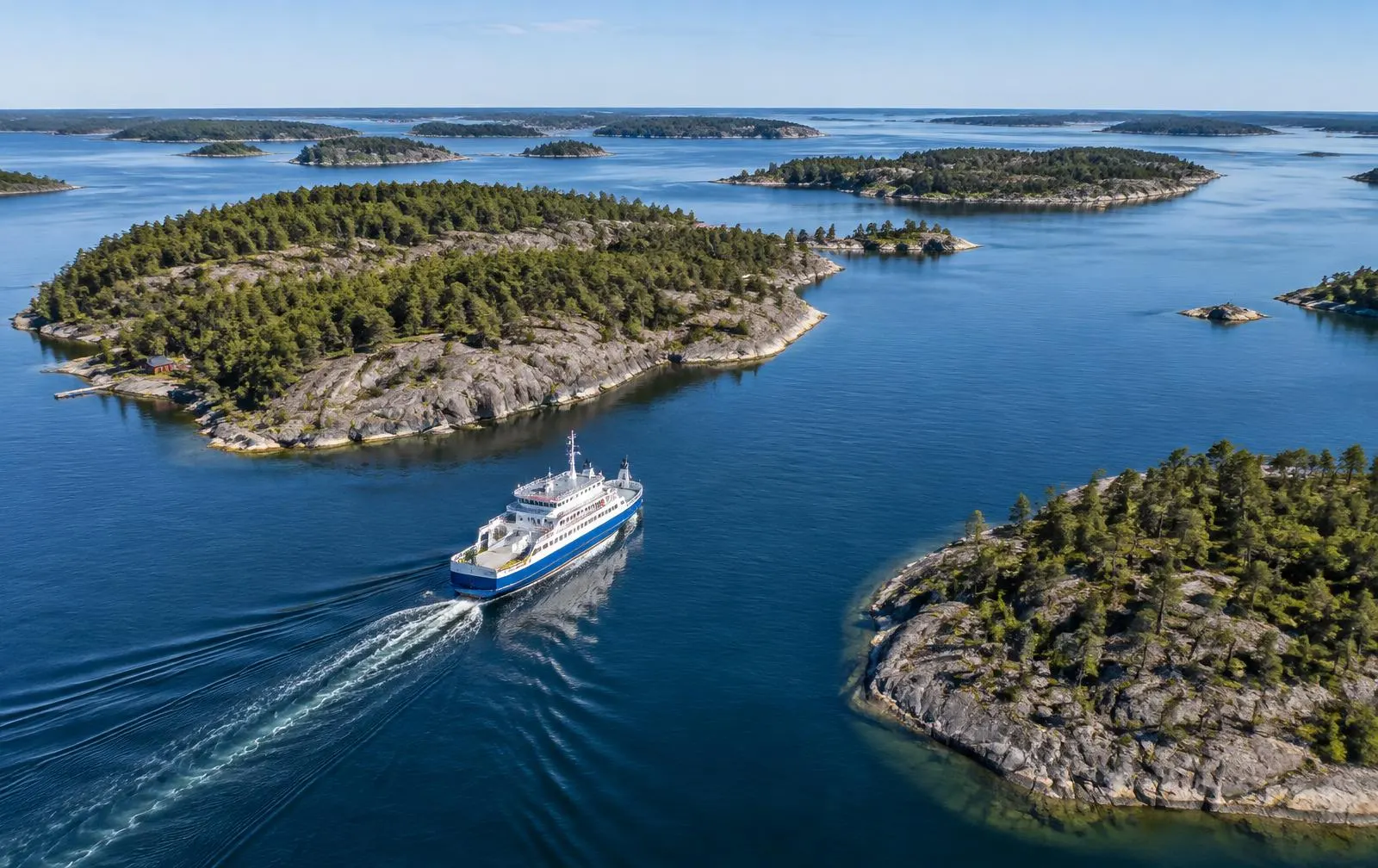
Åland lies at the entrance to the Gulf of Bothnia, roughly midway between Stockholm and Turku. It consists of more than 6,500 islands and skerries, of which around 60 are inhabited. In 1921 the League of Nations confirmed Finnish sovereignty over Åland, together with broad autonomy and demilitarisation; Swedish is the islands' sole official language. Mariehamn, founded in 1861, is its capital and principal port.

Early maritime trade
Åland farmers and sailors were active traders, carrying firewood, fish and farm produce to Stockholm in their own vessels. In the late nineteenth and early twentieth centuries Mariehamn became famous as the home port of one of the last fleets of large sailing ships, led by shipowner Gustaf Erikson, which carried grain from Australia until after the Second World War.
The development of Swedish and Finnish ports
On the Swedish side, Stockholm, Grisslehamn and Kapellskär developed as departure points; on the Finnish side, Turku and Naantali. Port development followed the shift from passengers to vehicles: car ferries needed ramps, parking lanes and road access rather than just quays.
Naantali's maritime importance
Naantali, a small historic town west of Turku, grew around a medieval Bridgettine convent. Its deep-water harbour later developed into one of Finland's busiest ports by cargo volume, serving industry and energy as well as ro-pax traffic. Its location gives a short road connection to Turku and the main highway to Helsinki.
Kapellskär as a ferry port
Kapellskär lies on the coast of Roslagen, about 90 kilometres north-east of central Stockholm. Its position at the outer edge of the Stockholm archipelago shortens the sea crossing to Åland and Finland compared with sailing from the city itself — saving several hours of navigation through the inner archipelago. It has been used for routes to Mariehamn and to Naantali.
Långnäs and the Åland Islands
Långnäs, on the eastern side of Åland's main island group, offers a deep-water harbour away from Mariehamn. It has served as a call on routes between Finland and Sweden, connecting Åland's eastern municipalities and allowing ships to stop in Åland without a detour. Searches for Kapellskär to Långnäs and Långnäs to Kapellskär generally relate to this intermediate call.
The development of regular ferry services
Steamships began scheduled passenger service between Stockholm and Turku in the 1830s, and by the early twentieth century Finnish companies such as FÅA and Bore operated regular routes. Winter ice remained a serious obstacle until stronger, ice-classed vessels and state icebreakers made year-round service reliable.
Automobile ferry transportation
The car-ferry era began in the late 1950s. Companies later known as Silja Line and Viking Line were formed to carry cars and passengers across the Åland Sea, and competition encouraged ever larger ships. Later, a freight-focused ro-pax link between Naantali and Kapellskär was established; operated by Finnlines as FinnLink, it is often searched for as the Naantali–Kapellskär ferry. New vessels, Finnsirius (2023) and Finncanopus (2024), entered service on the route with calls at Långnäs.
Modern Sweden–Finland ferry connections
Today's network includes Stockholm–Helsinki and Stockholm–Turku routes via Åland, Kapellskär–Mariehamn, Grisslehamn–Eckerö, Naantali–Kapellskär via Långnäs, and northern routes across the Kvarken. Each route has its own character, from overnight cruise ferries to freight-oriented ro-pax vessels. Current schedules for any ferry from Sweden to Finland or Finland to Sweden should be checked with the operator.
| Corridor | Character |
|---|---|
| Stockholm–Helsinki | Overnight cruise ferries via Åland |
| Stockholm–Turku | Day and night crossings through the archipelago |
| Naantali–Långnäs–Kapellskär | Freight-led ro-pax |
| Kapellskär–Mariehamn / Grisslehamn–Eckerö | Short Åland Sea crossings |
How travellers describe these routes
The Naantali route is variously searched for as the Kapellskär Naantali ferry, Kapellskär to Naantali or Naantali to Kapellskär; the wider corridor as a Finland Sweden ferry, ferry Sweden Finland, ferry Finland Sweden or car ferry Sweden Finland. For the islands, people look for an Åland ferry, a Sweden Åland ferry, an Åland Islands ferry or the Långnäs Kapellskär ferry. In Finnlines' own network these appear as Finnlines Naantali, Finnlines Kapellskär and Finnlines Långnäs — check the official site for current details.
Historical timeline
- 1809Finland separated from SwedenAfter the Finnish War, Finland becomes a Grand Duchy of the Russian Empire; Sweden–Finland crossings become international.
- 1830sSteam on the Åland SeaSteamships begin regular passenger service between Stockholm and Turku via the archipelago.
- 1921Åland autonomyThe League of Nations confirms Finnish sovereignty over Åland with autonomy and demilitarisation.
- 1957–59Car-ferry companiesCompanies later known as Silja Line (1957) and Viking Line (1959) begin car-ferry operations across the Åland Sea.
- Late 1980sNaantali–KapellskärA freight-focused ro-pax link between Naantali and Kapellskär is established, later operated as FinnLink by Finnlines.
- 2023FinnsiriusA new ro-pax vessel enters Naantali–Långnäs–Kapellskär service.
- 2024FinncanopusA sister ship joins the same route.
Frequently asked questions
What is the Naantali–Kapellskär ferry?
A ro-pax route linking Naantali, near Turku in south-west Finland, with Kapellskär, north-east of Stockholm in Sweden. It is freight-oriented with passenger accommodation and has been associated with Finnlines.
Does the Kapellskär–Långnäs ferry call at Åland?
Långnäs on Åland's eastern side has served as an intermediate call on Naantali–Kapellskär sailings in recent years. Confirm current calls with the official operator.
How do Åland ferry connections work?
Åland is linked to Sweden and mainland Finland by several ferry operators and by Åland's own archipelago ferry network. Mariehamn and Långnäs are the main ports for international traffic.
Can I take a car on a Sweden–Finland ferry?
Yes. Car ferries between Sweden and Finland have carried private vehicles since the late 1950s. Vehicle rules and fares are set by each operator.
Why do Sweden–Finland ferries stop in Åland?
Åland has a special tax status within the EU, and calls there have historically allowed duty-free sales on board, as well as serving the islanders' own transport needs.