The crossing between Travemünde and Malmö belongs to one of Europe's oldest maritime relationships — the exchange between the German Baltic coast and southern Sweden. This page follows that relationship from Hanseatic trade to the modern ro-pax ferry.
Travemünde ↔ Malmö
Schematic only — not a navigational chart and not a statement of current sailings.
Historical connections between Germany and Sweden
Swedish copper and iron flowed to Lübeck in the Middle Ages, while German merchants settled in Stockholm and Visby. During the Thirty Years' War and afterwards, Sweden held territories on the German Baltic coast, including Swedish Pomerania and Wismar. Close cultural and economic ties made Germany–Sweden ferry history a continuous story rather than a modern invention.
The development of Travemünde
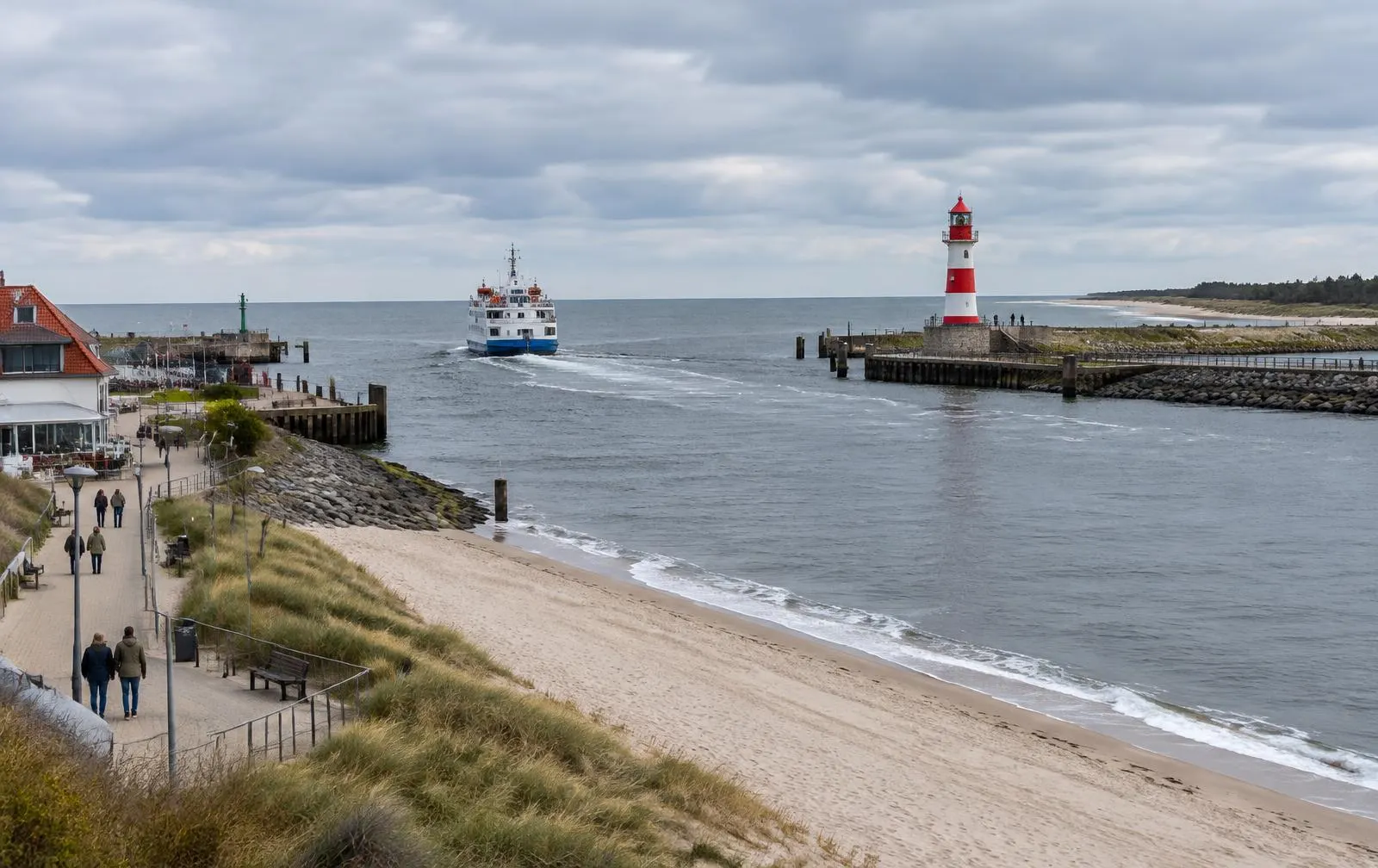
As Lübeck's outport, Travemünde benefited from the city's long trading tradition. Its deep-water berths at the river mouth made it suitable for large modern vessels, and from the 1960s it became one of the principal German terminals for Scandinavian traffic. The Skandinavienkai terminal handles ro-ro freight and passenger ferries to Sweden, Finland and other Baltic countries.
Malmö as a Swedish port
Malmö was a Danish town until the Treaty of Roskilde in 1658 transferred Scania to Sweden. In the nineteenth and twentieth centuries it grew into an industrial city with shipyards — Kockums was among the most important — and a busy port facing the Øresund. Since the opening of the Øresund Bridge in 2000, Malmö has been part of a cross-border region with Copenhagen, but its port continues to serve ferry and freight traffic to Germany and Poland.
The growth of regular ferry transportation
Scheduled steamship services linked German and Swedish ports in the nineteenth century. In 1909 the Sassnitz–Trelleborg train ferry created a permanent rail link between the two countries. After 1945 West German–Swedish traffic shifted westward, and in 1962 TT-Line began car-ferry operations between Trelleborg and Travemünde — the initials stand for the two ports. A separate ro-pax service between Malmö and Travemünde developed later, in the 1990s, oriented toward freight with passenger capacity.
The rise of automobile ferries
Growing car ownership in both countries from the 1950s created demand for routes that could carry private vehicles. Holidaymakers from Germany drove to Swedish lakes and coasts, and Swedes drove south to continental Europe. A car ferry between Germany and Sweden offered an alternative to the Danish routes and the fixed links built later.
Freight and passenger transportation
The Malmö–Travemünde route is a good example of a freight-led ro-pax service. Lorries and trailers form the backbone of the traffic, while passengers — often with cars — share the vessel. Drivers can take their legally required rest during the crossing, which makes overnight or long-day sailings attractive for hauliers.
The role of Finnlines
In the 2000s the Malmö–Travemünde service became part of the Finnlines network, after the company took over the operation previously marketed as Nordö-Link. This places Malmö alongside Finnlines' other Baltic routes in historical accounts. Finnlinec is independent and reports this as historical information only.
Modern Germany–Sweden ferry connections
Several ferry corridors link the two countries today, including routes from Trelleborg to Travemünde, Rostock and Sassnitz, and from Gothenburg to Kiel, alongside the Malmö route. Whether you are researching a ferry from Germany to Sweden or Sweden to Germany, current operators, vessels and departure times must be confirmed with each company.
| Corridor | Historical note |
|---|---|
| Sassnitz–Trelleborg | Train ferry from 1909 ("Königslinie") |
| Trelleborg–Travemünde | Car ferry service by TT-Line from 1962 |
| Malmö–Travemünde | Freight-led ro-pax route developed from the 1990s |
| Gothenburg–Kiel | Long-established overnight passenger route |
How travellers describe this route
Searches for a Malmö Travemünde ferry, Malmö to Travemünde, a Sweden Germany ferry, a ferry Germany Sweden or a ferry Sweden Germany all point to the same historical corridor. A car ferry Germany Sweden journey has been possible here for decades, but operational details belong to the operator.
Historical timeline
- c. 1275Malmö charteredMalmö receives town privileges as a Danish market town on the Øresund.
- 1658Malmö becomes SwedishThe Treaty of Roskilde transfers Scania, including Malmö, from Denmark to Sweden.
- 1909Sassnitz–TrelleborgThe Königslinie train ferry links German and Swedish railways.
- 1962TT-Line foundedTT-Line begins car-ferry service between Trelleborg and Travemünde.
- 1990sMalmö–Travemünde ro-paxA dedicated ro-pax service, later known as Nordö-Link, develops between Malmö and Travemünde.
- 2000Øresund BridgeThe fixed link between Malmö and Copenhagen opens, changing southern Sweden's transport geography.
- 2000sFinnlines involvementThe Malmö–Travemünde service becomes part of the Finnlines network.
Frequently asked questions
Is there a ferry from Travemünde to Malmö?
A Malmö–Travemünde ro-pax route has been operated in recent decades, most recently associated with Finnlines. Check the official operator's website for current sailings.
How long has Germany–Sweden ferry travel existed?
Steamship links date to the nineteenth century, rail ferries began in 1909 (Sassnitz–Trelleborg) and car ferries spread from the 1960s, including Trelleborg–Travemünde from 1962.
Why choose a ferry rather than the bridges?
A direct ferry from northern Germany to southern Sweden avoids driving through Denmark and paying for the fixed links. For freight, it allows driver rest time during the crossing.
Which other Germany–Sweden routes exist?
Historically important routes include Trelleborg–Travemünde, Trelleborg–Rostock, Trelleborg–Sassnitz and Gothenburg–Kiel. Operators and timetables change; consult each company directly.
Can I book a Travemünde–Malmö ticket here?
No. Finnlinec is an independent history website and has no booking facility. For finnlines malmo or finnlines travemunde tickets, use finnlines.com.