For more than half a century, the sea route between Travemünde and Helsinki has been one of the principal maritime links between Germany and Finland. It crosses almost the full length of the Baltic proper, from the Bay of Lübeck to the Gulf of Finland, and has been shaped by geography, trade and changing technology.
Travemünde ↔ Helsinki
Schematic only — not a navigational chart and not a statement of current sailings.
Why Germany and Finland needed maritime connections
Finland is, in transport terms, almost an island. Its land borders are with Sweden and Norway in the far north and with Russia to the east. Reaching Central Europe by land means either a very long drive around the Gulf of Bothnia or crossing through Russia and the Baltic states. A direct sea route to northern Germany offered a shorter and more predictable alternative, especially for heavy freight.
Germany, meanwhile, was a principal destination for Finnish timber, paper and later machinery, and a source of manufactured goods. The commercial rationale for a Germany–Finland ferry link therefore rested on trade long before it rested on tourism.
Travemünde as a Baltic port
Travemünde lies at the mouth of the River Trave, about 20 kilometres downstream from Lübeck. Lübeck acquired it in 1329 to control access to the sea, and for centuries it served as the outport of the "Queen of the Hanse". In the nineteenth century Travemünde also became a seaside resort. In the twentieth century the port facilities at Skandinavienkai were developed into one of Germany's largest ferry and ro-ro terminals, with direct motorway and rail access.
Helsinki's maritime importance
Helsinki was founded by King Gustav Vasa in 1550 and became Finland's capital in 1812, when Finland was a Grand Duchy under the Russian Empire. Its sheltered harbours made it the country's main gateway for passengers. Over time freight and long-distance ferry traffic concentrated at Vuosaari harbour, opened in 2008 in the east of the city, while the historic South and West Harbours remained busy with passenger services to Stockholm and Tallinn.
The development of Germany–Finland ferry services
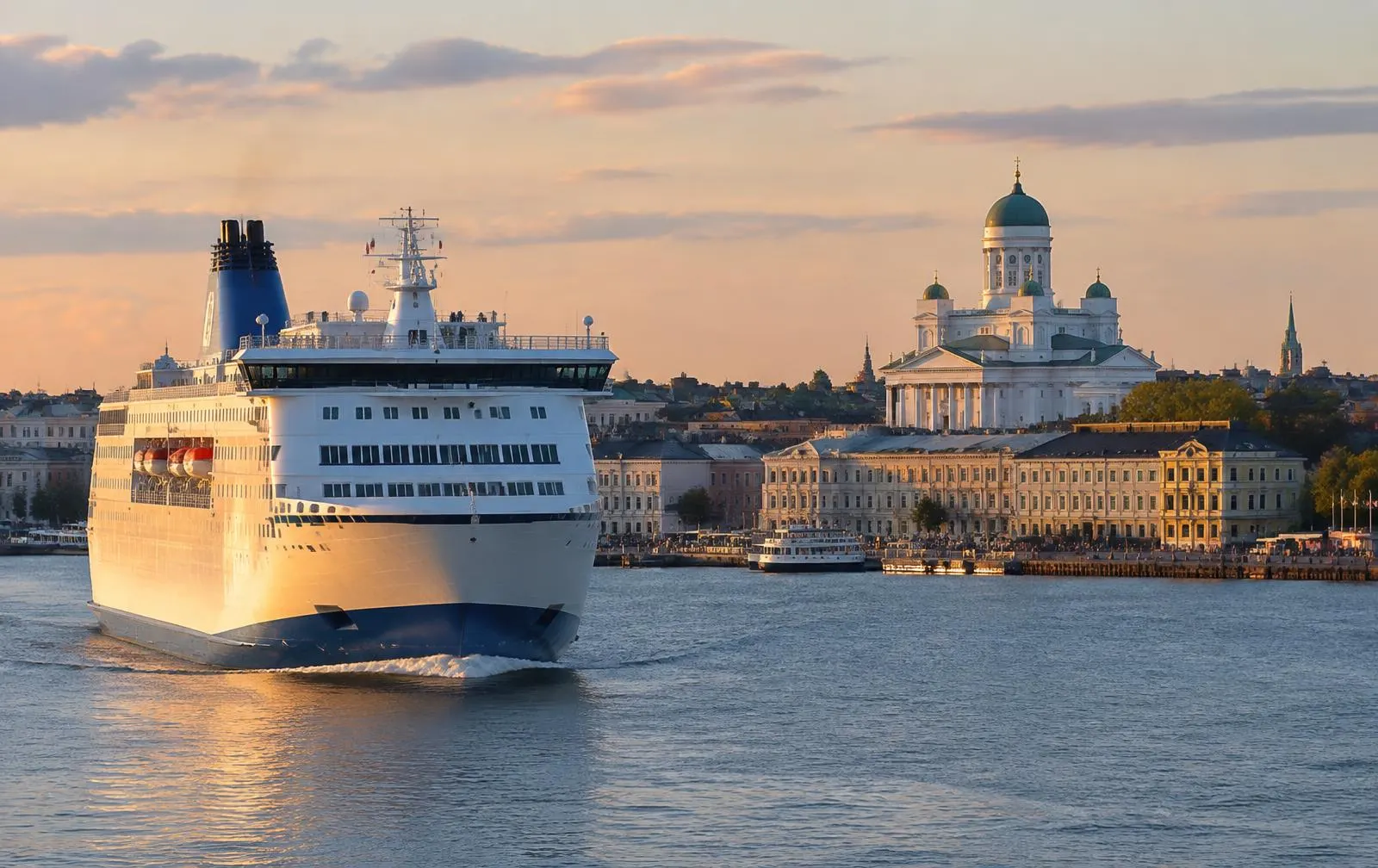
Steamship lines connected Finnish ports with Lübeck and Stettin in the nineteenth century, and the Finnish company FÅA operated continental services before the Second World War. After 1945, with the eastern Baltic coast closed off, a link to West Germany took on new significance.
In 1966 Finnlines' Finnhansa and Finnpartner opened a passenger and car service between Helsinki and Travemünde. In 1977 the company introduced Finnjet, a large gas-turbine-powered ship that significantly cut the crossing time and became a symbol of the route. In the following decades the route was increasingly served by ro-pax vessels, such as the Star class (Finnstar, Finnmaid and Finnlady) introduced in 2006–07, which combine extensive freight decks with passenger cabins.
Passenger and freight transportation
The economics of the route depend on combining two kinds of traffic. Lorries and unaccompanied trailers provide steady year-round volume, while passengers — many travelling with cars or caravans — peak in summer. Ro-pax design allows both to share a single vessel. This combination is why travemunde helsinki ferry services have historically emphasised capacity and reliability rather than the entertainment-focused style of shorter "cruise ferry" routes.
Overnight ferry travel
A crossing of this length cannot be completed in a single day, so overnight accommodation has always been central. Ships on the route have offered cabins, restaurants, saunas and lounges. For many travellers the voyage — whether Travemünde to Helsinki or Helsinki to Travemünde — becomes a mini-cruise in its own right. See Overnight ferries and the evolution of Baltic travel.
Car ferry transportation
From the 1960s, Finnish and German motorists began to use the route as a way to take their own cars between the Nordic countries and Central Europe. A car ferry between Germany and Finland avoids around 2,000 kilometres of overland driving via Sweden and Denmark. Today the vehicle decks of ro-pax ships handle everything from private cars and motorcycles to heavy goods vehicles.
The role of Finnlines
Finnlines is the company most closely associated with the route in its modern form, having operated it since the 1960s. Finnlinec mentions the company here only in its historical context; we are not affiliated with it. Searches for finnlines ferry, finnlines booking or finnlines tickets should be directed to the official Finnlines website, which is the only authoritative source for bookings.
Modern ferry travel between Germany and Finland
The route remains an important part of the Baltic ferry network between Germany and Finland for both freight and passengers. Departure days, crossing times, vessel deployment and fares change over time and are not reproduced here. Travellers searching for a ferry from Finland to Germany should check the official operator for current information.
How travellers describe this route
Because the crossing works in both directions, people search for it in many ways: a Helsinki Travemünde ferry, a Finland Germany ferry, a ferry Germany Finland or simply a ferry Finland Germany. Whatever the wording, the history is the same — a Baltic ferry Germany Finland link built on trade. Anyone planning a car ferry Germany Finland trip should rely on the operator for current details.
Historical timeline
- 1329Travemünde joins LübeckLübeck acquires Travemünde, securing its outport at the mouth of the Trave.
- 1550Helsinki foundedKing Gustav Vasa of Sweden founds Helsinki as a trading town on the Gulf of Finland.
- 1812Helsinki becomes capitalThe Grand Duchy of Finland moves its capital from Turku to Helsinki.
- 1917Finnish independenceFinland declares independence; continental trade links gain new importance.
- 1947Finnlines foundedFinnlines is established in Helsinki as a cargo shipping company.
- 1966Passenger and car serviceFinnhansa and Finnpartner begin carrying passengers and cars between Helsinki and Travemünde.
- 1977Finnjet enters serviceThe gas-turbine Finnjet shortens the crossing to roughly a day.
- 2006–07Star-class ro-pax shipsFinnstar, Finnmaid and Finnlady enter Helsinki–Travemünde service.
Frequently asked questions
What is the Travemünde–Helsinki ferry?
It is a long-distance sea route between Travemünde, the Baltic port of Lübeck in northern Germany, and Helsinki in Finland. It has historically been served by ro-pax vessels carrying freight vehicles, cars and passengers, typically on a crossing of more than a day.
Why is the route important?
It links Finland directly with the German road and rail network, avoiding a long overland detour around the Gulf of Bothnia. For freight it is a core part of Finland's trade with Central Europe; for travellers it is a way to reach continental Europe with a car.
How did overnight ferry travel develop?
Long Baltic crossings could not be completed in a day, so ships were fitted with cabins, restaurants and lounges. The voyage itself became part of the journey, with travellers sleeping on board.
Can vehicles travel on Baltic Sea ferries?
Yes. Most ferries on the major Baltic routes are roll-on/roll-off ships that carry cars, motorcycles, caravans and lorries. Conditions and vehicle rules are set by each operator.
Where can current ferry schedules be found?
Only on the operator's official website. Finnlinec does not publish timetables, fares or availability. For finnlines helsinki or finnlines travemunde sailings, visit finnlines.com.